In computational learning theory (machine learning and theory of computation), Rademacher complexity, named after Hans Rademacher, measures richness of a class of sets with respect to a probability distribution. The concept can also be extended to real valued functions. == Definitions == === Rademacher complexity of a set === Given a set A ⊆ R m {\displaystyle A\subseteq \mathbb {R} ^{m}} , the Rademacher complexity of A is defined as follows: Rad ( A ) := 1 m E σ [ sup a ∈ A ∑ i = 1 m σ i a i ] {\displaystyle \operatorname {Rad} (A):={\frac {1}{m}}\mathbb {E} _{\sigma }\left[\sup _{a\in A}\sum _{i=1}^{m}\sigma _{i}a_{i}\right]} where σ 1 , σ 2 , … , σ m {\displaystyle \sigma _{1},\sigma _{2},\dots ,\sigma _{m}} are independent random variables drawn from the Rademacher distribution i.e. Pr ( σ i = + 1 ) = Pr ( σ i = − 1 ) = 1 / 2 {\displaystyle \Pr(\sigma _{i}=+1)=\Pr(\sigma _{i}=-1)=1/2} for i ∈ { 1 , 2 , … , m } {\displaystyle i\in \{1,2,\dots ,m\}} , and a = ( a 1 , … , a m ) ∈ A {\displaystyle a=(a_{1},\ldots ,a_{m})\in A} . Some authors take the absolute value of the sum before taking the supremum, but if A {\displaystyle A} is symmetric this makes no difference. === Rademacher complexity of a function class === Let S = { z 1 , z 2 , … , z m } ⊆ Z {\displaystyle S=\{z_{1},z_{2},\dots ,z_{m}\}\subseteq Z} be a sample of points and consider a function class F {\displaystyle {\mathcal {F}}} of real-valued functions over Z {\displaystyle Z} . Then, the empirical Rademacher complexity of F {\displaystyle {\mathcal {F}}} given S {\displaystyle S} is defined as: Rad S ( F ) = 1 m E σ [ sup f ∈ F | ∑ i = 1 m σ i f ( z i ) | ] {\displaystyle \operatorname {Rad} _{S}({\mathcal {F}})={\frac {1}{m}}\mathbb {E} _{\sigma }\left[\sup _{f\in {\mathcal {F}}}\left|\sum _{i=1}^{m}\sigma _{i}f(z_{i})\right|\right]} This can also be written using the previous definition: Rad S ( F ) = Rad ( F ∘ S ) {\displaystyle \operatorname {Rad} _{S}({\mathcal {F}})=\operatorname {Rad} ({\mathcal {F}}\circ S)} where F ∘ S {\displaystyle {\mathcal {F}}\circ S} denotes function composition, i.e.: F ∘ S := { ( f ( z 1 ) , … , f ( z m ) ) ∣ f ∈ F } {\displaystyle {\mathcal {F}}\circ S:=\{(f(z_{1}),\ldots ,f(z_{m}))\mid f\in {\mathcal {F}}\}} The worst case empirical Rademacher complexity is Rad ¯ m ( F ) = sup S = { z 1 , … , z m } Rad S ( F ) {\displaystyle {\overline {\operatorname {Rad} }}_{m}({\mathcal {F}})=\sup _{S=\{z_{1},\dots ,z_{m}\}}\operatorname {Rad} _{S}({\mathcal {F}})} Let P {\displaystyle P} be a probability distribution over Z {\displaystyle Z} . The Rademacher complexity of the function class F {\displaystyle {\mathcal {F}}} with respect to P {\displaystyle P} for sample size m {\displaystyle m} is: Rad P , m ( F ) := E S ∼ P m [ Rad S ( F ) ] {\displaystyle \operatorname {Rad} _{P,m}({\mathcal {F}}):=\mathbb {E} _{S\sim P^{m}}\left[\operatorname {Rad} _{S}({\mathcal {F}})\right]} where the above expectation is taken over an identically independently distributed (i.i.d.) sample S = ( z 1 , z 2 , … , z m ) {\displaystyle S=(z_{1},z_{2},\dots ,z_{m})} generated according to P {\displaystyle P} . == Intuition == The Rademacher complexity is typically applied on a function class of models that are used for classification, with the goal of measuring their ability to classify points drawn from a probability space under arbitrary labellings. When the function class is rich enough, it contains functions that can appropriately adapt for each arrangement of labels, simulated by the random draw of σ i {\displaystyle \sigma _{i}} under the expectation, so that this quantity in the sum is maximized. The Rademacher complexity of a set A {\displaystyle A} can be rewritten as Rad ( A ) := 1 m E σ [ sup a ∈ A ∑ i = 1 m σ i a i ] = 1 m 2 m ∑ σ ∈ { − 1 / m , + 1 / m } m [ sup a ∈ A ⟨ σ , a ⟩ ] . {\displaystyle \operatorname {Rad} (A):={\frac {1}{m}}\mathbb {E} _{\sigma }\left[\sup _{a\in A}\sum _{i=1}^{m}\sigma _{i}a_{i}\right]={\frac {1}{{\sqrt {m}}2^{m}}}\sum _{\sigma \in \{-1/{\sqrt {m}},+1/{\sqrt {m}}\}^{m}}\left[\sup _{a\in A}\langle \sigma ,a\rangle \right].} Each term in the summation is the farthest distance of the set A {\displaystyle A} from the origin, along a unit-length direction σ {\displaystyle \sigma } . The directions are along the vertices of a hypercube. Thus, we can also write it as Rad ( A ) = 1 2 m 1 2 m − 1 ∑ σ ∈ { − 1 / m , + 1 / m } m / { − 1 , + 1 } [ sup a ∈ A ⟨ σ , a ⟩ − inf a ∈ A ⟨ σ , a ⟩ ] {\displaystyle \operatorname {Rad} (A)={\frac {1}{2{\sqrt {m}}}}{\frac {1}{2^{m-1}}}\sum _{\sigma \in \{-1/{\sqrt {m}},+1/{\sqrt {m}}\}^{m}/\{-1,+1\}}\left[\sup _{a\in A}\langle \sigma ,a\rangle -\inf _{a\in A}\langle \sigma ,a\rangle \right]} Here, the set { − 1 / m , + 1 / m } m / { − 1 , + 1 } {\displaystyle \{-1/{\sqrt {m}},+1/{\sqrt {m}}\}^{m}/\{-1,+1\}} denotes half of the vertices of a hypercube, selected so that each diagonal has exactly one vertex selected. In words, this states that 2 m Rad ( A ) {\displaystyle 2{\sqrt {m}}\operatorname {Rad} (A)} is precisely the average width of the set A {\displaystyle A} along all diagonal directions of a hypercube. == Examples == A singleton set has 0 width in any direction, so it has Rademacher complexity 0. The set A = { ( 1 , 1 ) , ( 1 , 2 ) } ⊆ R 2 {\displaystyle A=\{(1,1),(1,2)\}\subseteq \mathbb {R} ^{2}} has average width 1 / 2 {\displaystyle 1/{\sqrt {2}}} along the two diagonal directions of the square, so it has Rademacher complexity 1 / 4 {\displaystyle 1/4} . The unit cube [ 0 , 1 ] m {\displaystyle [0,1]^{m}} has constant width m {\displaystyle {\sqrt {m}}} along the diagonal directions, so it has Rademacher complexity 1 / 2 {\displaystyle 1/2} . Similarly, the unit cross-polytope { x ∈ R m : ‖ x ‖ 1 ≤ 1 } {\displaystyle \{x\in \mathbb {R} ^{m}:\|x\|_{1}\leq 1\}} has constant width 2 / m {\displaystyle 2/{\sqrt {m}}} along the diagonal directions, so it has Rademacher complexity 1 / m {\displaystyle 1/m} . == Using the Rademacher complexity == The Rademacher complexity can be used to derive data-dependent upper-bounds on the learnability of function classes. Intuitively, a function-class with smaller Rademacher complexity is easier to learn. === Bounding the representativeness === In machine learning, it is desired to have a training set that represents the true distribution of some sample data S {\displaystyle S} . This can be quantified using the notion of representativeness. Denote by P {\displaystyle P} the probability distribution from which the samples are drawn. Denote by H {\displaystyle H} the set of hypotheses (potential classifiers) and denote by F {\displaystyle {\mathcal {F}}} the corresponding set of error functions, i.e., for every hypothesis h ∈ H {\displaystyle h\in H} , there is a function f h ∈ F {\displaystyle f_{h}\in F} , that maps each training sample (features,label) to the error of the classifier h {\displaystyle h} (note in this case hypothesis and classifier are used interchangeably). For example, in the case that h {\displaystyle h} represents a binary classifier, the error function is a 0–1 loss function, i.e. the error function f h {\displaystyle f_{h}} returns 0 if h {\displaystyle h} correctly classifies a sample and 1 else. We omit the index and write f {\displaystyle f} instead of f h {\displaystyle f_{h}} when the underlying hypothesis is irrelevant. Define: L P ( f ) := E z ∼ P [ f ( z ) ] {\displaystyle L_{P}(f):=\mathbb {E} _{z\sim P}[f(z)]} – the expected error of some error function f ∈ F {\displaystyle f\in {\mathcal {F}}} on the real distribution P {\displaystyle P} ; L S ( f ) := 1 m ∑ i = 1 m f ( z i ) {\displaystyle L_{S}(f):={1 \over m}\sum _{i=1}^{m}f(z_{i})} – the estimated error of some error function f ∈ F {\displaystyle f\in {\mathcal {F}}} on the sample S {\displaystyle S} . The representativeness of the sample S {\displaystyle S} , with respect to P {\displaystyle P} and F {\displaystyle {\mathcal {F}}} , is defined as: Rep P ( F , S ) := sup f ∈ F ( L P ( f ) − L S ( f ) ) {\displaystyle \operatorname {Rep} _{P}({\mathcal {F}},S):=\sup _{f\in F}(L_{P}(f)-L_{S}(f))} Smaller representativeness is better, since it provides a way to avoid overfitting: it means that the true error of a classifier is not much higher than its estimated error, and so selecting a classifier that has low estimated error will ensure that the true error is also low. Note however that the concept of representativeness is relative and hence can not be compared across distinct samples. The expected representativeness of a sample can be bounded above by the Rademacher complexity of the function class: If F {\displaystyle {\mathcal {F}}} is a set of functions with range within [ 0 , 1 ] {\displaystyle [0,1]} , then Rad P , m ( F ) − ln 2 2 m ≤ E S ∼ P m [ Rep P ( F , S ) ] ≤ 2 Rad P , m ( F ) {\displaystyle \operatorname {Rad} _{P,m}({\mathcal {F}})-{\sqrt {\frac {\ln 2}{2m}}}\leq \mathbb {E} _{S\sim P^{m}}[\operatorname {Rep} _{P}({\
Screen generator
A screen generator, also known as a screen painter, screen mapper, or forms generator is a software package (or component thereof) which enables data entry screens to be generated declaratively, by "painting" them on the screen WYSIWYG-style, or through filling-in forms, rather than requiring writing of code to display them manually. 4GLs commonly incorporate a screen generator feature. They are also commonly found bundled with database systems, especially entry-level databases. A screen generator is one aspect of an application generator, which can also include other functions such as report generation and a data dictionary. The earliest screen generators were character-based; by the 1990s, GUI support became common, and then support for generating HTML forms as well. Some screen generators work by generating code to display the screen in a high-level language (for example, COBOL); others store the screen definition in a data file or in database tables, and then have a runtime component responsible for actually displaying the form and receiving and validating user input. == Examples == Examples of screen generators include: IBM Screen Definition Facility II: generates screens for CICS BMS, IMS MFS, ISPF, GDDM and CSP/AD. Performix for Informix. Microsoft Visual Basic the forms component of Microsoft Access Oracle Developer, in particular its Oracle Forms component the QDesign component of PowerHouse SystemBuilder/SB+ the Screen Painter component of SAP's ABAP Workbench the FoxView component of FoxPro. FoxView was originally developed by Luis Castro as a dBASE screen generator named ViewGen; Fox purchased it and bundled it with FoxPro 1.0. Later, Fox replaced Castro's code with their own screen painter code. dBASE included a built-in screen generator in dBASE IV onwards; in dBASE III and earlier, third party screen generators were available, including the already mentioned ViewGen DPS 1100 for UNIVAC 1100 series mainframes.
Fuzzy differential inclusion
Fuzzy differential inclusion is the extension of differential inclusion to fuzzy sets introduced by Lotfi A. Zadeh. x ′ ( t ) ∈ [ f ( t , x ( t ) ) ] α {\displaystyle x'(t)\in [f(t,x(t))]^{\alpha }} with x ( 0 ) ∈ [ x 0 ] α {\displaystyle x(0)\in [x_{0}]^{\alpha }} Suppose f ( t , x ( t ) ) {\displaystyle f(t,x(t))} is a fuzzy valued continuous function on Euclidean space. Then it is the collection of all normal, upper semi-continuous, convex, compactly supported fuzzy subsets of R n {\displaystyle \mathbb {R} ^{n}} . == Second order differential == The second order differential is x ″ ( t ) ∈ [ k x ] α {\displaystyle x''(t)\in [kx]^{\alpha }} where k ∈ [ K ] α {\displaystyle k\in [K]^{\alpha }} , K {\displaystyle K} is trapezoidal fuzzy number ( − 1 , − 1 / 2 , 0 , 1 / 2 ) {\displaystyle (-1,-1/2,0,1/2)} , and x 0 {\displaystyle x_{0}} is a trianglular fuzzy number (-1,0,1). == Applications == Fuzzy differential inclusion (FDI) has applications in Cybernetics Artificial intelligence, Neural network, Medical imaging Robotics Atmospheric dispersion modeling Weather forecasting Cyclone Pattern recognition Population biology
Futuresport
Futuresport is a 1998 American made-for-television sports film directed by Ernest Dickerson, starring Dean Cain, Vanessa Williams, and Wesley Snipes. It originally aired on ABC in October 1998, was released on VHS and DVD in March 1999 and then distributed outside of the U.S. by Minerva Pictures. == Plot == The film is set in 2025, and centers on a sport called "Futuresport" (a combination of basketball, baseball and hockey that uses hoverboards and rollerblades) created as a non-lethal way to reduce gang warfare. Tre Ramzey (Dean Cain) along with his ex-girlfriend Alex Torres (Vanessa Williams) and his old coach Obike Fixx (Wesley Snipes) must prevent an all out war between the North American Alliance and the Pan-Pacific Commonwealth (The Com). At stake is who rules over the Hawaiian Islands—which are being terrorized by Eric Sythe (JR Bourne) and his gang the Hawaiian Liberation Organization (Hilo). It takes a revolutionary sport to stop a revolution. == Cast ==
Terminator (franchise)
Terminator is an American media franchise created by James Cameron and Gale Anne Hurd. It is considered to be of the cyberpunk subgenre of science fiction. The franchise primarily focuses on the events leading to a future post-apocalyptic war between a synthetic intelligence known as Skynet, and a surviving resistance of humans led by John Connor. In this future, Skynet uses an arsenal of cyborgs known as Terminators, designed to mimic humans and infiltrate the resistance. Much of the franchise takes place in time periods prior to the Skynet takeover, with both humans and Terminators using time travel to attempt to alter the past and change the outcome of the future. A prominent Terminator model throughout the films is the T-800, commonly known as "the Terminator", with instances of this model portrayed by Arnold Schwarzenegger. The franchise began with the 1984 film The Terminator, written and directed by Cameron, with Hurd as producer. They would return for the 1991 sequel Terminator 2: Judgment Day (or T2). Both films were critical and commercial successes. Terminator 3: Rise of the Machines (or T3) was released in 2003 to positive reviews, followed by Terminator Salvation in 2009 to more negative reviews. Salvation was intended as the first in a new trilogy, which was later scrapped after the film rights were sold. Cameron was consulted for the 2015 film Terminator Genisys, a reboot branching off from the timeline of the original film. It was negatively received and performed poorly at the box-office. Cameron had a larger role as a producer of the 2019 film Terminator: Dark Fate, a direct sequel to T2 that ignores the three preceding films. As with Salvation, both Genisys and Dark Fate were planned as first installments of new trilogies, with the plans scrapped each time due to the films' poor box-office performances. Outside of the theatrical films, Cameron co-directed T2-3D: Battle Across Time, a 1996 theme park film-based attraction. It was produced as the original sequel to T2 and reunited its main cast. A television series, Terminator: The Sarah Connor Chronicles, was developed without Cameron's involvement and aired for two seasons in 2008 and 2009. It was also produced as a T2 sequel, taking place in an alternate timeline that ignores the third film and subsequent events. Terminator Zero, an anime series, premiered in August 2024. The franchise has also inspired several lines of comic books since 1988, and numerous video games since 1991. By 2010, the franchise had generated $3 billion in revenue. == Themes and setting == The central theme of the franchise is the battle for survival between the nearly-extinct human race and the world-spanning, synthetic intelligence that is Skynet. Skynet is positioned in the first film, The Terminator (1984), as a U.S. strategic "Global Digital Defense Network" computer system by Cyberdyne Systems which becomes self-aware. Shortly after activation, Skynet seemingly perceives all humans as a threat to its existence and formulates a plan to systematically wipe out humanity itself. The system initiates a nuclear first strike against Russia, thereby ensuring a devastating second strike and a nuclear holocaust which wipes out much of humanity in the resulting nuclear war. In the post-apocalyptic aftermath, Skynet later builds up its own autonomous machine-based military capability which includes the Terminators used against individual human targets and thereafter proceeds to wage a persistent total war against the surviving elements of humanity, some of whom have militarily organized themselves into a Resistance. At some point in this future, Skynet develops the capability of time travel and both it and the Resistance seek to use this technology in order to win the war; either by altering or accelerating past events or by preventing the apocalyptic timeline. === Judgment Day === In the franchise, Judgment Day (a reference to the biblical Day of Judgment) is the date on which Skynet becomes self-aware, in which case its creators panic and attempt to deactivate the network. As a result, Skynet perceives humanity as a threat and attempts to exterminate them. Skynet launches an all-out nuclear attack on Russia in order to provoke a nuclear counter-strike against the United States, knowing this will eliminate its human enemies. Due to time travel and the consequent ability to change the future, several differing dates are given for Judgment Day. In Terminator 2: Judgment Day (1991), Sarah Connor states that Judgment Day will occur on August 29, 1997. However, this date is delayed following the attack on Cyberdyne Systems in the same film. Judgment Day has various different dates in different timelines of the subsequent films, as well as the television series, creating a multiverse of temporal phenomena. In Terminator 3: Rise of the Machines (2003) and Terminator Salvation (2009), Judgment Day was postponed to July 2003. In Terminator: The Sarah Connor Chronicles (2008–2009), the attack on Cyberdyne Systems in the second film delayed Judgment Day to April 21, 2011. In Terminator Genisys (2015), the fifth film in the franchise, Judgment Day was postponed to an unspecified day in October 2017, attributed to altered events in both the future and the past. Sarah and Kyle Reese travel through time to the year 2017 and seemingly defeat Skynet, but the system core, contained inside a subterranean blast shelter, survives unknown to them, thus further delaying, rather than preventing, Judgment Day. In Terminator: Dark Fate (2019), the direct sequel to Terminator 2: Judgment Day, a date is not given for the new Judgment Day though it is named as such by Grace. Since Grace is a ten-year-old in 2020 and shown as a teenager in the post-Judgment Day world in flash-forwards throughout the film, Judgment Day occurs sometime in the early 2020s in this timeline. == Franchise rights == Before the first film was created, director James Cameron sold the rights for $1 to Gale Anne Hurd, his future wife, who produced the film, under the strict provision that he be allowed to direct it. Hemdale Film Corporation also became a 50-percent owner of the franchise rights, until its share was sold in 1990 to Carolco Pictures, a company founded by Andrew G. Vajna and Mario Kassar. Terminator 2: Judgment Day was released a year later. Carolco filed for bankruptcy in 1995 and its library was subsequently acquired by StudioCanal, which continues to own the franchise today. However, the rights to future Terminator films were ultimately put up for auction. By that time, Cameron had become interested in making a Terminator 3 film. The rights were ultimately auctioned to Vajna in 1997, for $8 million. Vajna and Kassar spent another $8 million to purchase Hurd's half of the rights in 1998, becoming the full owners of the franchise. Hurd was initially opposed to the sale of the rights, while Cameron had lost interest in the franchise and a third film. After the 2003 release of Terminator 3: Rise of the Machines, the franchise rights were sold in 2007 for about $25 million to The Halcyon Company, which produced Terminator Salvation in 2009. Later that year, the company faced legal issues and filed for bankruptcy, putting the franchise rights up for sale. The rights were valued at about $70 million. In 2010, the rights were sold for $29.5 million to Pacificor, a hedge fund that was Halcyon's largest creditor. In 2012, the rights were sold to Megan Ellison and her production company Annapurna Pictures for less than $20 million, a lower price than what was previously offered. The low price was because of the possibility of Cameron regaining the rights in 2019, as a result of new North American copyright laws. Megan's brother David Ellison and Skydance Productions produced Terminator Genisys in 2015. Cameron worked together with David Ellison to produce the 2019 film Terminator: Dark Fate. As the film neared its release, Hurd filed to terminate a copyright grant made 35 years earlier. Under this move, Hurd would again become a 50-percent owner of the rights with Cameron and Skydance could lose the rights to make any additional Terminator films beginning in November 2020, unless a new deal is worked out. Skydance responded that it had a deal in place with Cameron and that it "controls the rights to the Terminator franchise for the foreseeable future". == Films == === The Terminator (1984) === The Terminator is a 1984 science fiction action film released by Orion Pictures, co-written and directed by James Cameron and starring Arnold Schwarzenegger, Linda Hamilton and Michael Biehn. It is the first work in the Terminator franchise. In the film, robots take over the world in the near future, directed by the artificial intelligence Skynet. With its sole mission to completely annihilate humanity, it develops android assassins called Terminators that outwardly appear human. A man named John Connor starts the Tech-Com resistance to fight the machi
Quantum robotics
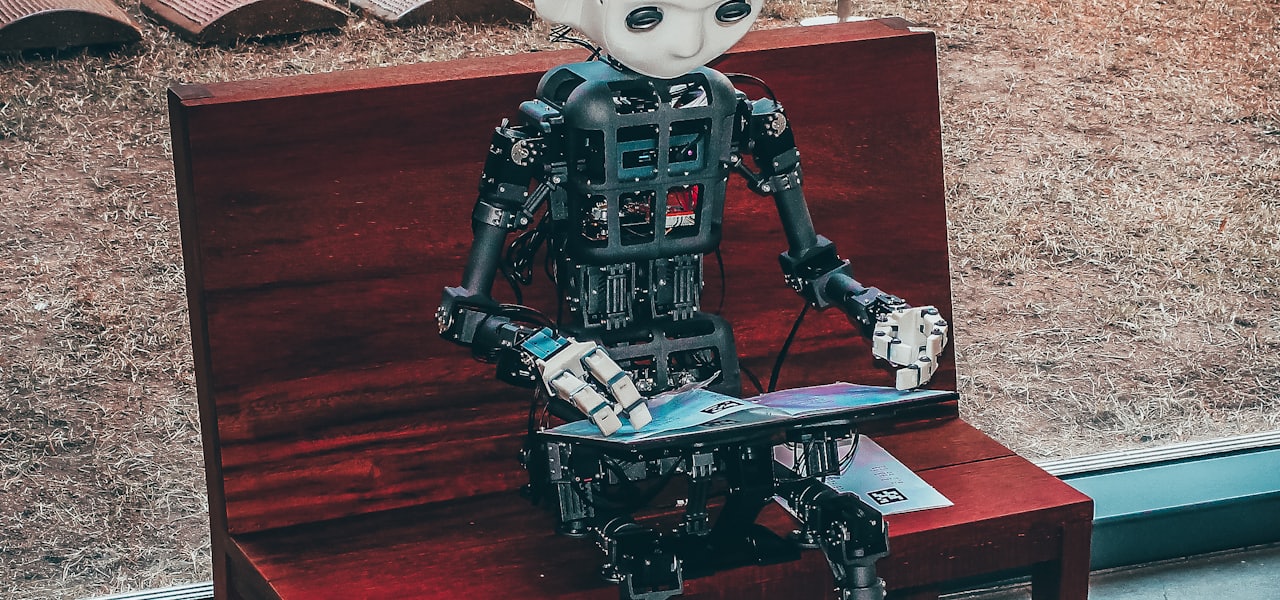
Quantum robotics is an interdisciplinary field that investigates the intersection of robotics and quantum mechanics. This field, in particular, explores the applications of quantum phenomena such as quantum entanglement within the realm of robotics. Examples of its applications include quantum communication in multi-agent cooperative robotic scenarios, the use of quantum algorithms in performing robotics tasks, and the integration of quantum devices (e.g., quantum detectors) in robotic systems. == Introduction == The free-space quantum communication between mobile platforms was proposed for reconfigurable quantum key distribution (QKD) applications using unmanned aerial vehicle (UAVs, a.k.a. drones) in 2017. This technology was later advanced in various aspects in mobile drone and vehicle platforms in several configurations such as drone-to-drone, drone-to-moving vehicle, and vehicle-to-vehicle systems. Some research has contributed to low-size, low-weight, and low-power quantum key distribution systems for small-form UAVs, the characterization of a polarization-based receiver for mobile free-space optical QKD, and optical-relayed entanglement distribution using drones as mobile nodes. The topic of free-space quantum communication between mobile platforms, initially developed to meet the need for free-space QKD and entanglement distribution using mobile nodes, was brought into the robotics domain as an emerging interdisciplinary mechatronics topic to investigate the interface between quantum technologies and the robotic systems domain. The main advantage of such integrated technology is the guaranteed security in communication between multi-agent and cooperative autonomous systems. Other advances are anticipated. == Quantum entanglement == According to quantum mechanics, entanglement occurs when more than one particle become connected. If the state of one particle changes then it will instantly change the state of other particles regardless of their distance. Entangled sensors do the same kind of work and achieve strong sensitivity. A group of quantum robots can measure magnetic fields, gravitational fields and other physical properties using entangled sensors with high rate of accuracy. Again the connection of one robot to other is increased (become strong) by quantum entanglement. == Quantum teleportation == Quantum teleportation is the transfer of quantum information (not physical objects). This is used in case of multi robot process. One robot is programmed with a complex quantum update. Then that robot can teleport that complex quantum information (the update) to other robots. This teleportation or communication is very secure because all the work is done in quantum state. == Kinematics == Quantum computing has been proposed as being optimal for calculating inverse kinematics values. == Alice and Bob robots == In the realm of quantum mechanics, the names Alice and Bob are frequently employed to illustrate various phenomena, protocols, and applications. These include their roles in QKD, quantum cryptography, entanglement, and teleportation. The terms "Alice Robot" and "Bob Robot" serve as analogous expressions that merge the concepts of Alice and Bob from quantum mechanics with mechatronic mobile platforms (such as robots, drones, and autonomous vehicles). For example, the Alice Robot functions as a transmitter platform that communicates with the Bob Robot, housing the receiving detectors.
Fuzzy pay-off method for real option valuation
The fuzzy pay-off method for real option valuation (FPOM or pay-off method) is a method for valuing real options, developed by Mikael Collan, Robert Fullér, and József Mezei; and published in 2009. It is based on the use of fuzzy logic and fuzzy numbers for the creation of the possible pay-off distribution of a project (real option). The structure of the method is similar to the probability theory based Datar–Mathews method for real option valuation, but the method is not based on probability theory and uses fuzzy numbers and possibility theory in framing the real option valuation problem. == Method == The Fuzzy pay-off method derives the real option value from a pay-off distribution that is created by using three or four cash-flow scenarios (most often created by an expert or a group of experts). The pay-off distribution is created simply by assigning each of the three cash-flow scenarios a corresponding definition with regards to a fuzzy number (triangular fuzzy number for three scenarios and a trapezoidal fuzzy number for four scenarios). This means that the pay-off distribution is created without any simulation whatsoever. This makes the procedure easy and transparent. The scenarios used are a minimum possible scenario (the lowest possible outcome), the maximum possible scenario (the highest possible outcome) and a best estimate (most likely to happen scenario) that is mapped as a fully possible scenario with a full degree of membership in the set of possible outcomes, or in the case of four scenarios used - two best estimate scenarios that are the upper and lower limit of the interval that is assigned a full degree of membership in the set of possible outcomes. The main observations that lie behind the model for deriving the real option value are the following: The fuzzy NPV of a project is (equal to) the pay-off distribution of a project value that is calculated with fuzzy numbers. The mean value of the positive values of the fuzzy NPV is the "possibilistic" mean value of the positive fuzzy NPV values. Real option value, ROV, calculated from the fuzzy NPV is the "possibilistic" mean value of the positive fuzzy NPV values multiplied with the positive area of the fuzzy NPV over the total area of the fuzzy NPV. The real option formula can then be written simply as: R O V = A ( P o s ) A ( P o s ) + A ( N e g ) × E [ A + ] {\displaystyle \mathrm {ROV} ={\frac {A(\mathrm {Pos} )}{A(\mathrm {Pos} )+A(\mathrm {Neg} )}}\times E[A_{+}]} where A(Pos) is the area of the positive part of the fuzzy distribution, A(Neg) is the area of the negative part of the fuzzy distribution, and E[A+] is the mean value of the positive part of the distribution. It can be seen that when the distribution is totally positive, the real options value reduces to the expected (mean) value, E[A+]. As can be seen, the real option value can be derived directly from the fuzzy NPV, without simulation. At the same time, simulation is not an absolutely necessary step in the Datar–Mathews method, so the two methods are not very different in that respect. But what is totally different is that the Datar–Mathews method is based on probability theory and as such has a very different foundation from the pay-off method that is based on possibility theory: the way that the two models treat uncertainty is fundamentally different. == Use of the method == The pay-off method for real option valuation is very easy to use compared to the other real option valuation methods and it can be used with the most commonly used spreadsheet software without any add-ins. The method is useful in analyses for decision making regarding investments that have an uncertain future, and especially so if the underlying data is in the form of cash-flow scenarios. The method is less useful if optimal timing is the objective. The method is flexible and accommodates easily both one-stage investments and multi-stage investments (compound real options). The method has been taken into use in some large international industrial companies for the valuation of research and development projects and portfolios. In these analyses triangular fuzzy numbers are used. Other uses of the method so far are, for example, R&D project valuation IPR valuation, valuation of M&A targets and expected synergies, valuation and optimization of M&A strategies, valuation of area development (construction) projects, valuation of large industrial real investments. The use of the pay-off method is lately taught within the larger framework of real options, for example at the Lappeenranta University of Technology and at the Tampere University of Technology in Finland.